


Asset location is one of the most overlooked levers in wealth management. By placing the right investments in the right accounts, we can meaningfully improve your after-tax returns - without changing a single holding.
Know Your Three Account Types
Each account has different tax treatment. Understanding the differences is the first step toward a smarter strategy.
| Account Type | Example | Description | Use |
|---|---|---|---|
| Taxable | Individual Stocks Index ETFs Muni Bonds | Flexible accounts with no contribution limits — but taxes apply every year on dividends, interest, and realized gains. | Long-term gains at favorable rates. Best for tax-efficient assets |
| Tax-Deferred | Traditional 401(k) IRA 403(b) Deferred variable annuities | Contributions may be deductible. All taxes are deferred until withdrawal, when distributions are taxed as ordinary income. | Ideal for high-yield, tax-inefficient assets. |
| Tax-Exempt | Roth IRA Roth 401(k) Roth 403(b) Health Savings Accounts (HSA) | After-tax contributions grow completely free of federal tax. Qualified withdrawals are never taxed — the most powerful vehicle for growth. | After-tax contributions; growth and qualified withdrawals are completely tax-free. |
Same Investment. Two Very Different Outcomes.
Consider a $250,000 investment in a taxable bond fund earning 6% annually, held for 20 years. Where you hold it makes a staggering difference in what you actually keep. The same dollars, the same investment, the same time horizon — but the account you choose can mean the difference of nearly $290,000 in after-tax wealth at retirement.
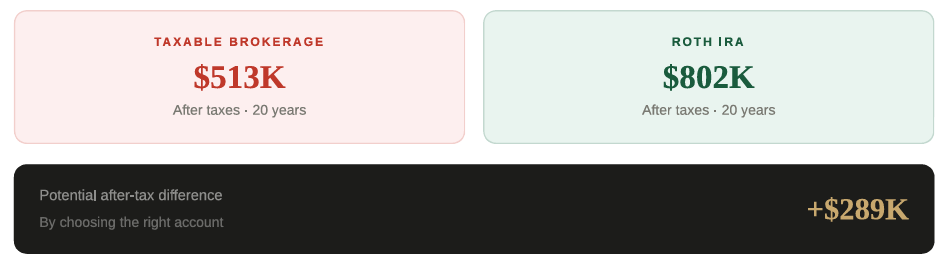
Assumptions: $250,000 initial investment - 6% annual return - 20-year horizon - 35.8% marginal income tax rate on net investment income. Hypothetical illustration only. Not a guarantee of future results.
Where to Put What
Not all investments are equal when it comes to taxes. Here's how to think about placement across your three account types.
| Investment Type | Taxable Account | Tax-Deferred | Tax-Exempt |
|---|---|---|---|
| Individual Stocks (held 1+ yr) | Best fit | Ok | Good |
| Equity Index ETFs & Funds | Best fit | Ok | Good |
| Municipal Bonds | Best fit | Avoid | Avoid |
| Taxable Bonds & Bond Funds | Avoid | Best fit | Good |
| REITs | Avoid | Best fit | Good |
| High-Yield / Emerging Market Bonds | Avoid | Good | Best fit |
| Actively Managed Stock Funds | Avoid | Best fit | Good |
| Growth Stocks & Alternatives | Ok | Ok | Best fit |
Four Signs Asset Location Can Help
The more of these that apply to your situation, the greater the potential benefit of a deliberate strategy.
You're in a High Tax Bracket Now
The higher your current marginal rate, the bigger the potential benefit. Deferring taxes on high-yield investments has compounding impact when you're in the 35-37% bracket.
You Expect a Lower Rate in Retirement
If you'll be in a lower bracket when you withdraw, asset location doesn't just defer taxes — it can permanently reduce them. Very common for pre-retirees.
You Hold Tax-Inefficient Assets in Taxable Accounts
Taxable bonds, REITs, and actively managed funds sitting in a brokerage account are generating unnecessary annual tax drag. Relocating them can be immediately impactful
Your Investing for the Long Term
Asset location compounds over time. The longer the horizon, the greater the impact — especially when annual tax savings are reinvested rather than paid to the IRS.
Let's Build Your Asset Location Strategy
Asset location is most powerful as part of a comprehensive financial plan. Let's review your accounts and find the opportunities hiding in plain sight. Schedule a portfolio review with our team so we can help you reach your financial goals.
Asset allocation is an investment strategy that will not guarantee a profit or protect you from loss. Asset allocation cannot eliminate the risk of fluctuating prices and uncertain returns.
Looking for More Financial Insights?
Browse our latest articles on retirement planning, investing, tax strategies, and more.
View All Articles