


I opened this series with a pitch deck a client forwarded me. Forty pages, the word “alternatives” more than a dozen times, and a one-word question: “Thoughts?”
The number that deck wanted me to look at was the yield. The paragraph that actually mattered sat several pages deeper, in smaller type, explaining when an investor is allowed to ask for their money back.
In the first quarter of this year, a lot of people went and read that paragraph.
Start with what you're being paid for
Private investments generally offer a higher expected return than public ones, and it's worth being precise about why. Some of it is credit risk — you're lending to borrowers who couldn't or wouldn't go to a bank. Some of it is complexity. But a meaningful piece is compensation for something simpler: you've agreed not to have your money back on demand.
That's the illiquidity premium. You're paid extra for accepting a restriction. It's a legitimate trade, and for money you genuinely won't need, it can be a smart one.
The problem arrives when a product is built to feel like it doesn't require that trade.
The mismatch at the center of it
Private credit funds make loans. Those loans typically run three to seven years. That's the asset.
Many of the vehicles sold to individual investors — interval funds and non-traded business development companies — offer investors a chance to redeem every quarter, usually capped somewhere in the range of 5% of the fund per quarter. That's the promise.
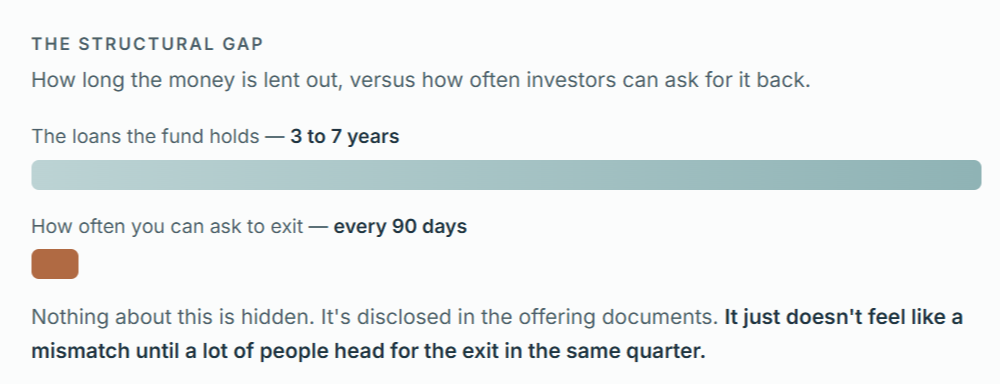
In ordinary conditions, the gap is manageable. Loans mature, borrowers refinance, new investors put money in, and the fund has plenty of cash to meet the handful of people who want out. Historically, the cash rolling in from prepayments and maturities has run well above what a quarterly cap would ever require.
Then this spring happened.
What the numbers looked like
Redemption requests at non-traded business development companies climbed steadily, then jumped. In the third quarter of 2025 they averaged well under 2% of fund assets. By the fourth quarter they had reached roughly 4.5%. In the first quarter of 2026 they ran in the range of 9% to 10% — roughly double what many of these vehicles are structured to pay out in a given quarter.
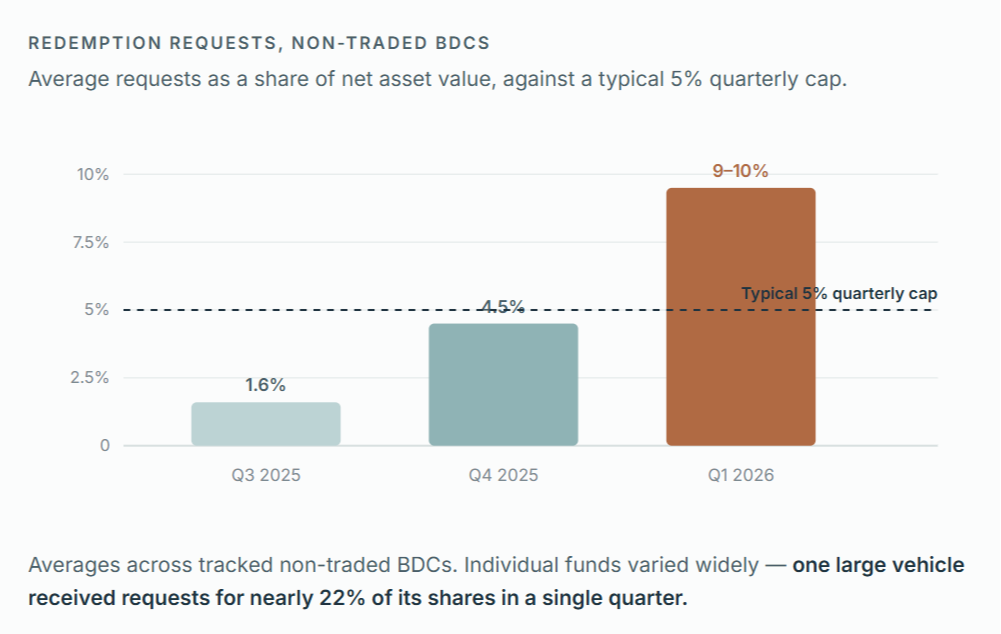
Individual funds ranged well beyond the average. One fund with more than $80 billion in assets received requests equal to roughly 8% of its portfolio. Another, holding around $36 billion, saw requests for nearly 22% of its shares in one quarter. A large interval fund received requests for about 14% of assets and paid out roughly half of that.
Which brings us to the part most investors had never thought about.
Gates, and why they exist
When requests exceed the cap, the fund doesn't sell whatever it must to meet them. It pays out up to the limit, prorates among everyone who asked, and tells the rest to wait for the next window. That mechanism is called a gate, and it was in the documents the whole time.
It's worth understanding that gates exist to protect the investors who stay. Without one, a fund facing heavy redemptions would have to dump its least liquid loans at whatever price it could get, and the cost of that fire sale would land on everyone still in the fund. The gate stops one group from cashing out at the expense of another.
Nothing broke this spring. The structures did precisely what they were designed to do. What surprised people was the design.
There is an uncomfortable second-order effect, though, and researchers have started documenting it. Because meeting redemptions is costly to the investors who remain, everyone has some incentive to be in the earlier group rather than the later one. A structure meant to prevent a rush can, at the margin, give people a reason to join it. That's a live debate in the academic literature right now, not a settled conclusion.
The counterargument deserves airtime too, because thoughtful people make it. These funds met their obligations. Many chose to repurchase more than they were required to. Leverage in the sector was lower than in earlier periods, and the ordinary cash flow these portfolios generate — loans maturing, borrowers refinancing — has historically run at a multiple of what a quarterly gate demands. Credit problems have been concentrated in smaller, more heavily indebted borrowers rather than spread across the market. A liquidity stress test is not the same thing as a credit crisis, and treating the two as identical would be its own kind of mistake.
What this should change about how you own it
Three Practical Adjustments
Not necessarily whether you own it. How much, and where it sits.
Give your portfolio a liquidity budget.Decide in advance what share of your assets you're willing to have restricted, using the fund's rules rather than its intentions. If a vehicle can gate at 5% a quarter, treat it as money you may not be able to reach for a year, not ninety days.
Don't count restricted assets as your reserve.The cash you'd tap for a new roof, a health event, or a bad market year needs to live somewhere you control. Semi-liquid does not mean available.
Read the redemption terms before the yield.The cap, the frequency, the proration method, and what the manager may do at their discretion. That paragraph tells you more about your actual risk than the headline distribution rate does.
The investors who had a difficult spring were not, for the most part, wrong about the asset class. Credit quality held up better than the headlines implied. They were wrong about how quickly they could leave, and they found out at the moment they most wanted to.
That's the trade at the center of every private investment. You're being paid to give something up. It's worth knowing exactly what, before you're paid the first dollar.
Next in this series
Where all of this actually fits: how to size private and alternative investments inside a real portfolio, and how we think about building around a household's liquidity rather than around a product.
Looking for More Financial Insights?
Browse our latest articles on retirement planning, investing, tax strategies, and more.
View All Articles