


Last time I made the case for renting the season before you buy it. A few people wrote back with the same reasonable question: fine, but what does it actually cost either way?
So let's run it.
A worked example
Take a $500,000 condo. Put 25% down, finance the rest at 6.5% over 30 years, and assume closing costs of about 3%. Property taxes at 1% of value, maintenance at 1.5%, insurance at $4,500, dues at $3,000, another $2,500 for utilities and upkeep. Assume the place appreciates 3% a year and it costs 7% to sell when you're done.
Against that, assume you'd otherwise rent a comparable place for $6,000 a month, three months a winter, with rent rising 3% a year.
Here's how ten years shakes out.
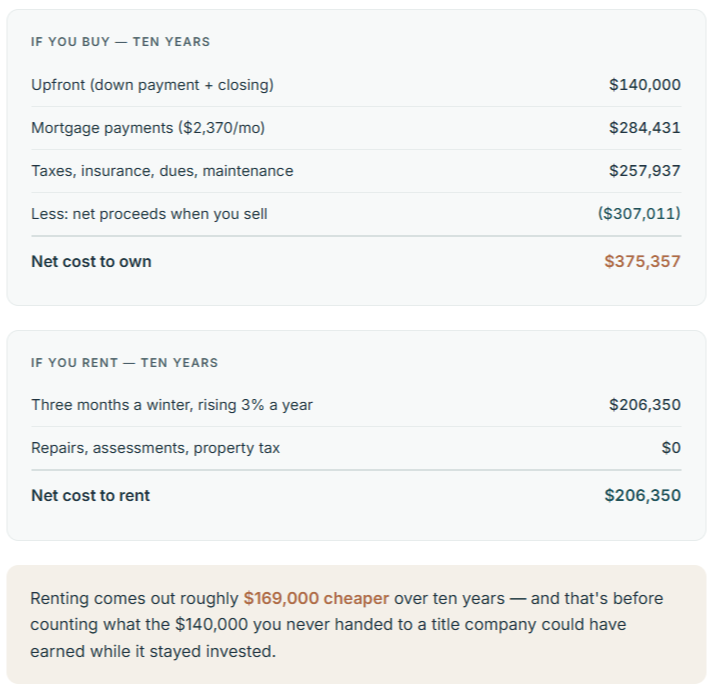
That last point deserves its own sentence, because it's the one that gets left out of almost every version of this conversation. The down payment isn't spent, exactly. It's converted — from liquid capital into an illiquid asset in a single geography that you can't sell a slice of when you need cash. At 6% a year, $140,000 compounds to roughly $251,000 over that same decade. The gap between those is a real cost of owning. It just never appears on a closing statement.
The three numbers that decide it
Change the assumptions and the answer changes. That's the point of running it rather than arguing about it.
1. Appreciation
This is the big one. At 3% a year, owning never catches renting in the example above. Push appreciation to 6% and owning pulls ahead around year nine. At 8%, it wins by year five. Everything hinges on a number nobody can promise you, in a market you'd be concentrated in.
2. Time horizon
Owning is a bet that gets better the longer you hold, because the fixed costs of buying and selling spread across more years. Which is exactly why selling within a year or two hurts so much — you pay the entry and exit costs and get none of the holding period that was supposed to justify them.
3. What the money would have done instead
Not just the down payment. The carrying costs too. Every dollar of property tax and every special assessment is a dollar not invested and not spent on something else.
Owning can absolutely win. It wins when appreciation is strong, you hold it a long time, and you use it enough to justify the carry. Those are three conditions, not one.
Run your own number in our calculator
Use our Second Home Calculator (here) to enter in your own figures. This calculator is a helpful tool to compare the full cost of owning against renting the same weeks each year.
What to do with the answer
If the numbers say renting wins by a wide margin and you want to buy anyway — buy. Just do it knowing it's a lifestyle purchase, priced accordingly, and not a financial decision you're going to be able to defend on a spreadsheet later.
If the numbers are close, then the tiebreakers are the ones the calculator can't score. How many years will you really use it. Whether you want to be in one place every winter or three different ones. Whether you want to own a roof in a hurricane zone at 78.
And if the numbers say renting wins and you find yourself relieved — that's information too.
Either way, run it before you make the offer, not after. The clients of mine who sold within a year weren't bad with money. They just answered a financial question with a feeling, in February, when Chicago was 8 degrees.
Looking for More Financial Insights?
Browse our latest articles on retirement planning, investing, tax strategies, and more.
View All Articles